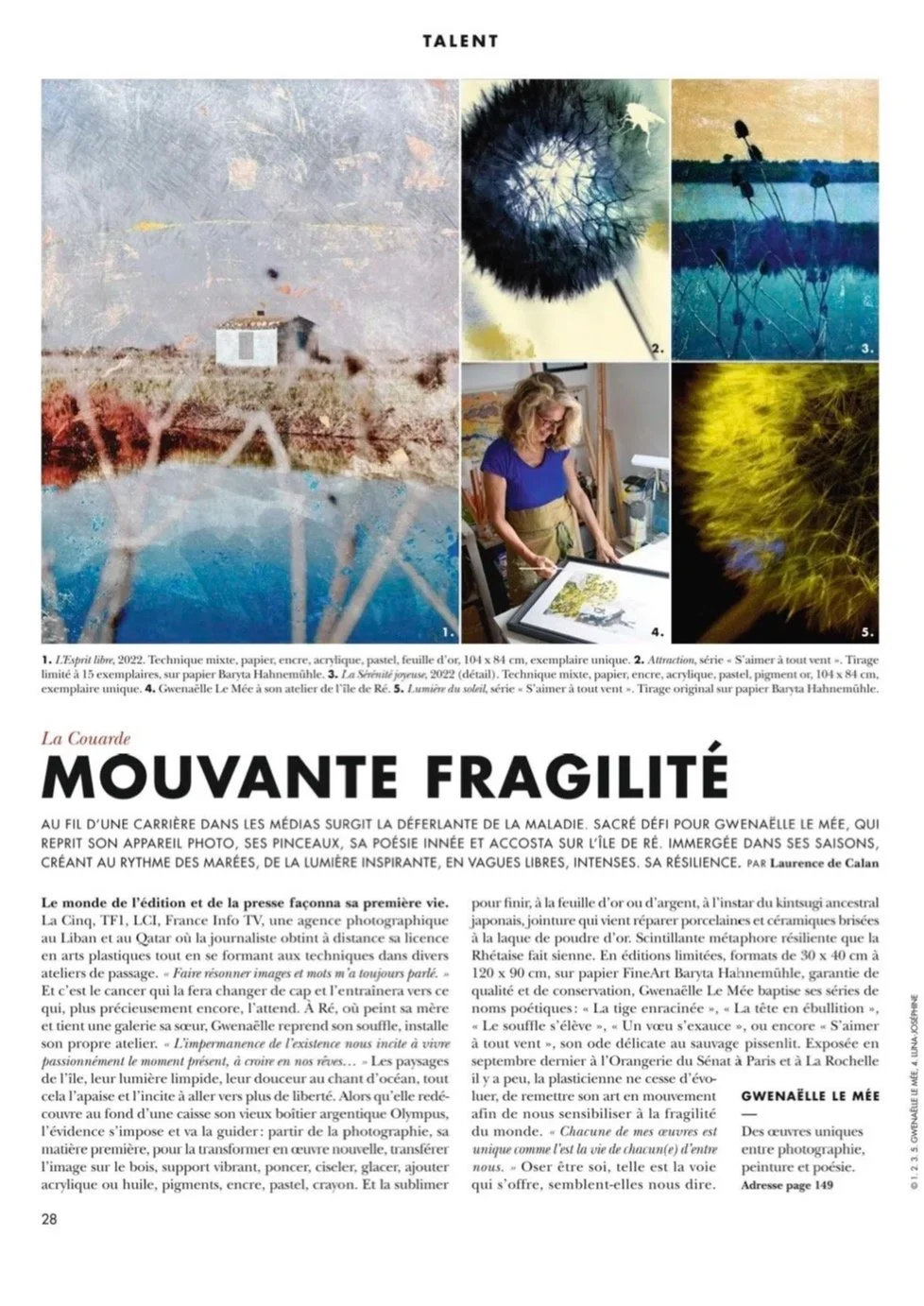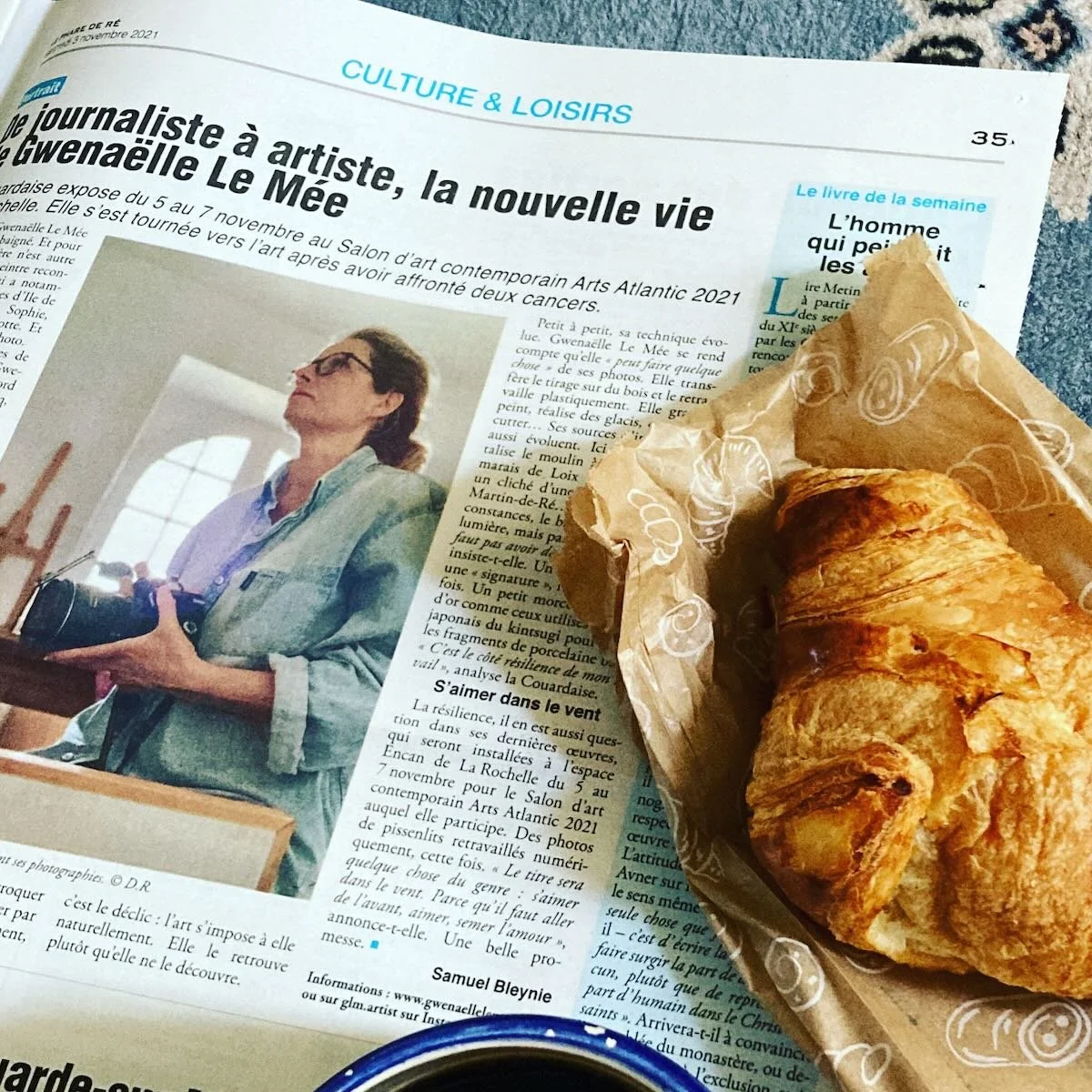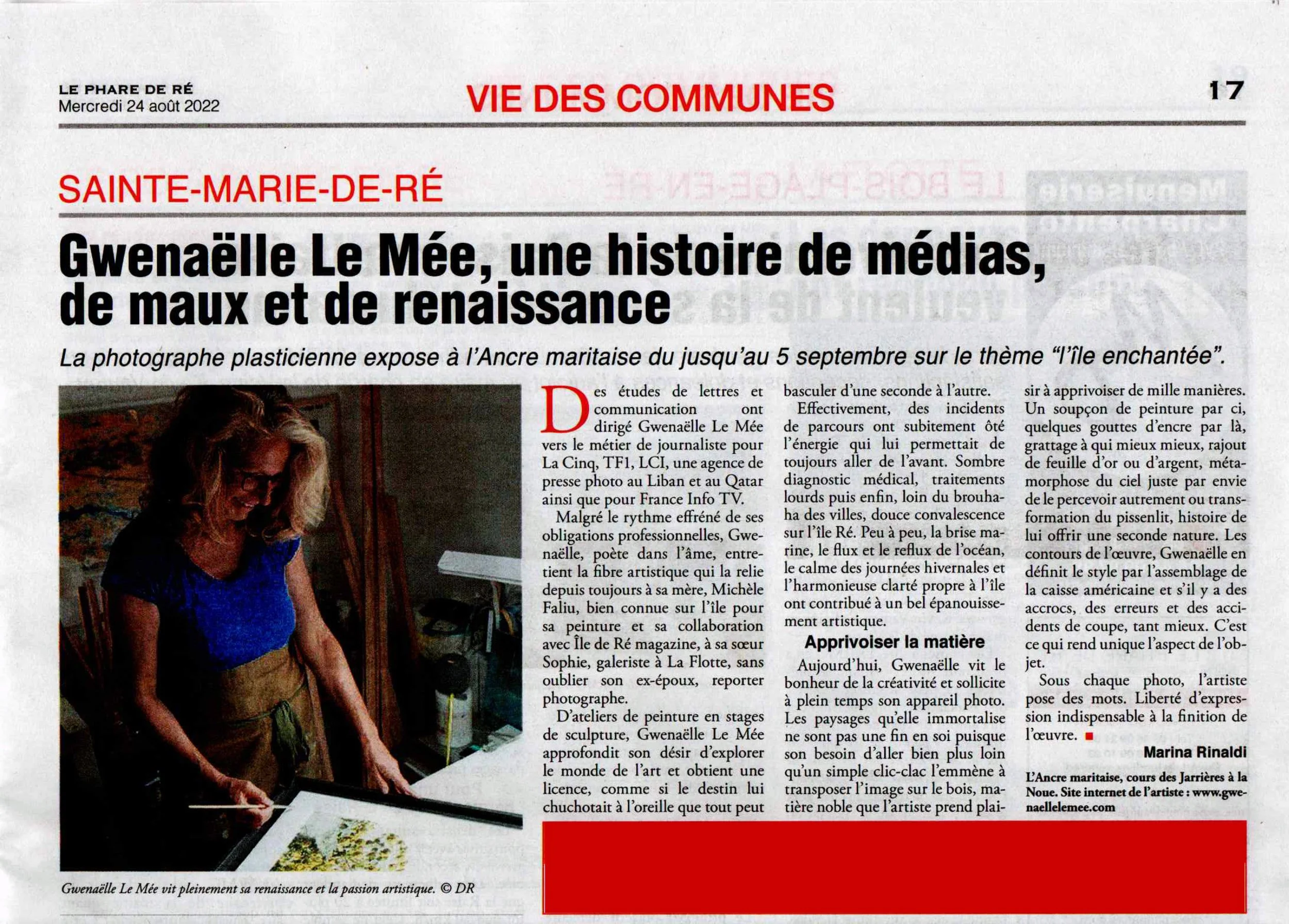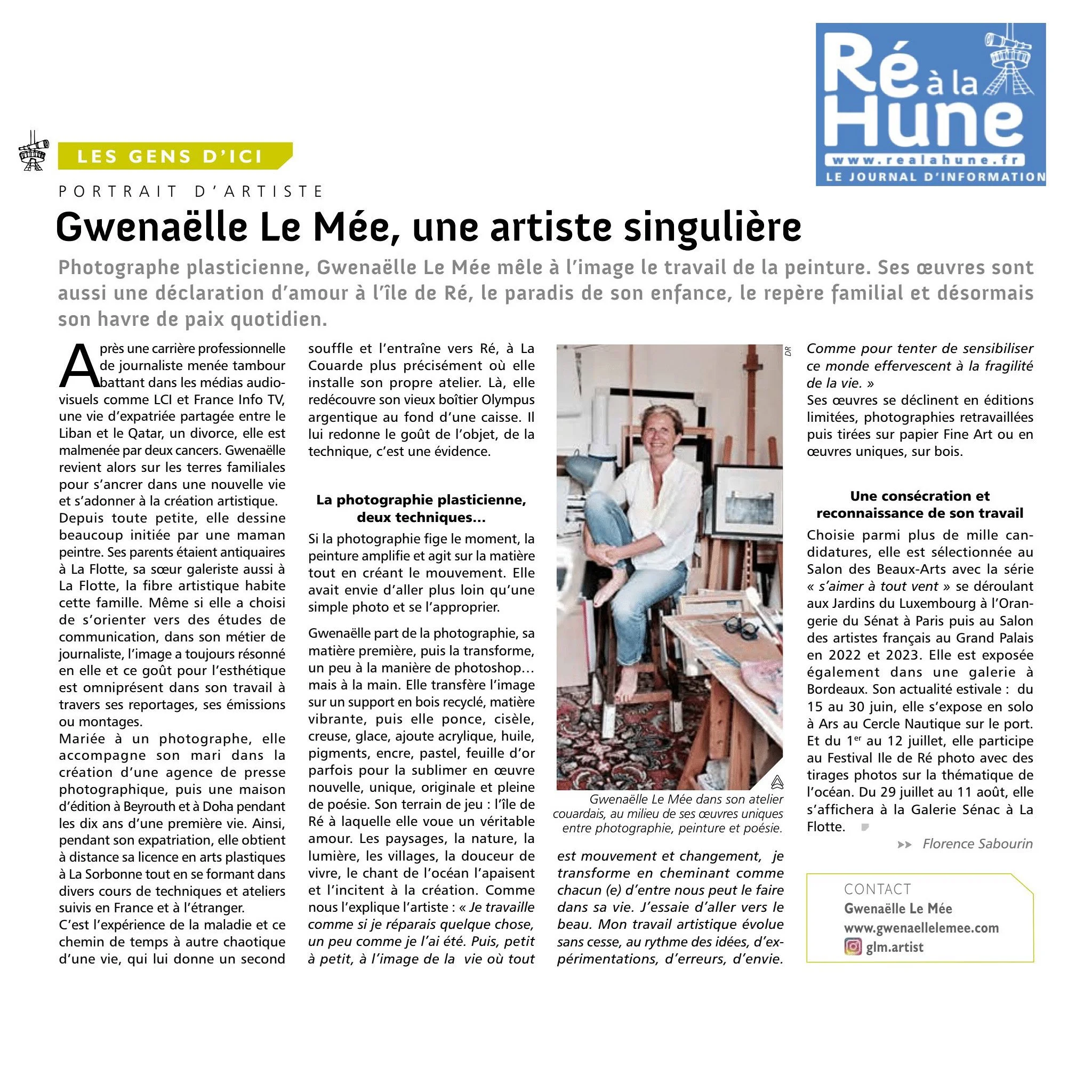
Her story
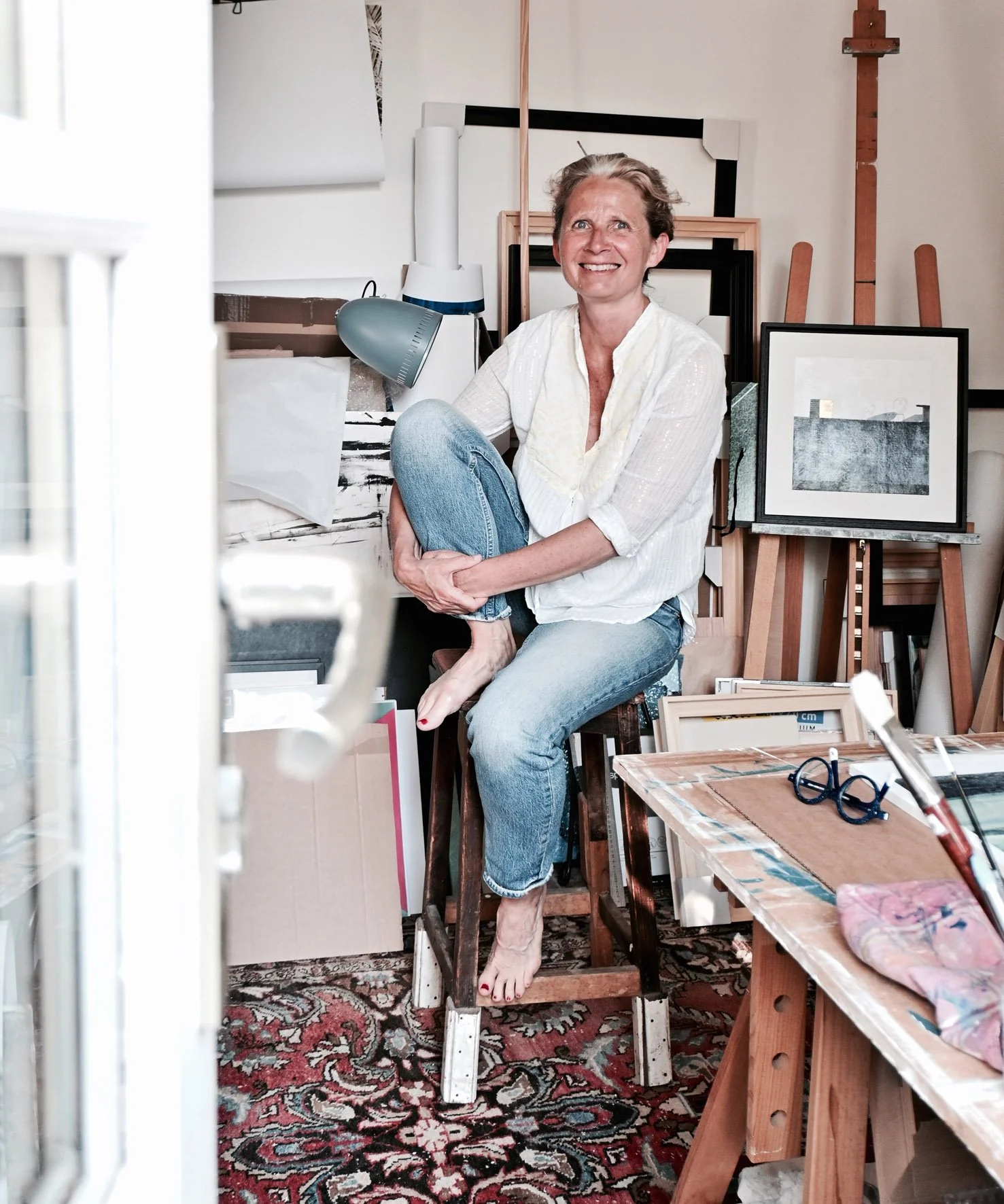
Born in 1967, having spent her childhood in Antibes and built her professional career in Paris and abroad, Gwenaëlle Le Mée is preparing to return to her family roots in the Pays du Léon region of northern Finistère.
Her interest in art began as a gentle sketch, a pastime, and a family tradition. This appreciation for aesthetics soon became part of her professional life.
A journalist, editor, art director, and publisher, her favorite mediums have always been images and words set to rhythm in a text, a layout, an edit, a broadcast, or a book.
Then came the time for the necessary temptation to experiment with it, to test it, and to put it into practice. Through various technical courses and workshops taken in Paris and abroad - including a long stint living abroad in Doha and Beirut - and earning a degree in fine arts from Panthéon-Sorbonne University in Paris, he initially gravitated toward abstraction, which offered complete freedom. The rediscovery of his old Olympus film camera at the bottom of a box rekindled his interest in the object and the technique. It was obvious.
Her life was turned upside down after battling two bouts of cancer. These trials did not become the subject of her art, but rather served as its catalyst: an invitation to live differently. She explores transience and transformation - realms where photography engages in a dialogue with painting and materiality.
The first time she experimented with the photographic transfer technique was during a project on the memory of places in the Middle East in 2012. From then on, the image would be tested, mistreated, then retouched and repaired with pigments, inks, glazes, or other experimental techniques, until movement emerged. She would link this choice of technique - a unique form of creation - to the act of repairing. Transcending wounds—both physical scars and those of the soul. The landscapes of the Atlantic coast and Iceland serve as a source of inspiration… and healing.
In recent months, Gwenaëlle Le Mée has decided to take her work in a new direction. A new phase, moving from repair to metamorphosis—“an optimistic and qualitative progression,” she says. She has now turned her attention to limited-edition pigment prints, whose light- and fade-resistant inks ensure museum-quality results. Her printing papers are carefully selected: Arches, eco-friendly Hahnemühle papers, or handmade Japanese papers. The tactile quality of the material remains a key focus for her. And the artistic gesture itself remains essential. Just as mounting on Japanese paper—carried out using traditional methods with starch glue and specialized brushes—requires concentration, a light touch, and meditation. “A rarity of slowness in this age of screens.” Creases or accidental marks sometimes become an integral part of the work. Each print is then enhanced by hand (using acrylic paint, watercolor, colored pencils, pastels, pure pigments, etc.), making each piece unique despite its serial nature. These precise and intuitive manual interventions transform each work into a hybrid of photography and painting.
Between Reality and Poetic Reinvention
My artistic approach is a conversation between reality and the imagination, where photography is merely a starting point—a raw material that I reinvent through layering, textures, chance, and gesture. At the heart of this process is the act of transformation, a manual intervention that breathes new life into the image.” Nature, a source of contemplative inspiration, guides each piece, whether it takes shape on paper, canvas, fabric, or another medium. Each work embodies this metamorphosis, in which the image unfolds into a sensory object, imbued with meaning and poetry. When the nature that inspires me wavers, my work becomes a refuge.
“What if art could, for a moment of contemplation, envelop the world in gentleness?”
Dates
-
Galerie Sophie Le Mée , La Flotte-en-Ré - Focus “Entre terre et mer” du 23 avril au 14 mai
L’art à la Perrière, Festival dans Le Perche (23I24I25 mai)
Expo4art, Halle des Blancs Manteaux, Paris 4e (29<31 mai)
Galerie Atiskal, Paris 6eme - Expo en duo avec Charlotte de Vogüé, du 8 au 1er octobre
-
Galerie Bettina , 2 rue Bonaparte, Paris 6eme
Galerie Hammer , 27 rue des vieux murs, Lille
Galerie Sophie Le Mée , La Flotte-en-Ré
Galerie Sénac , La Flotte – du 3 au 16 mai + 9 au 22 août - expo collective
Galerie Les Belles Vues , Auray avec l’expo collective BZH
-
Salon d’Automne, sélection 2024, à la Grande Halle de la Villette, Paris
Galerie Bettina, 2 rue Bonaparte, Paris 6eme
Galerie Sophie Le Mée, La Flotte-en-Ré
L’art à la Perrière, Festival dans Le Perche (mai)
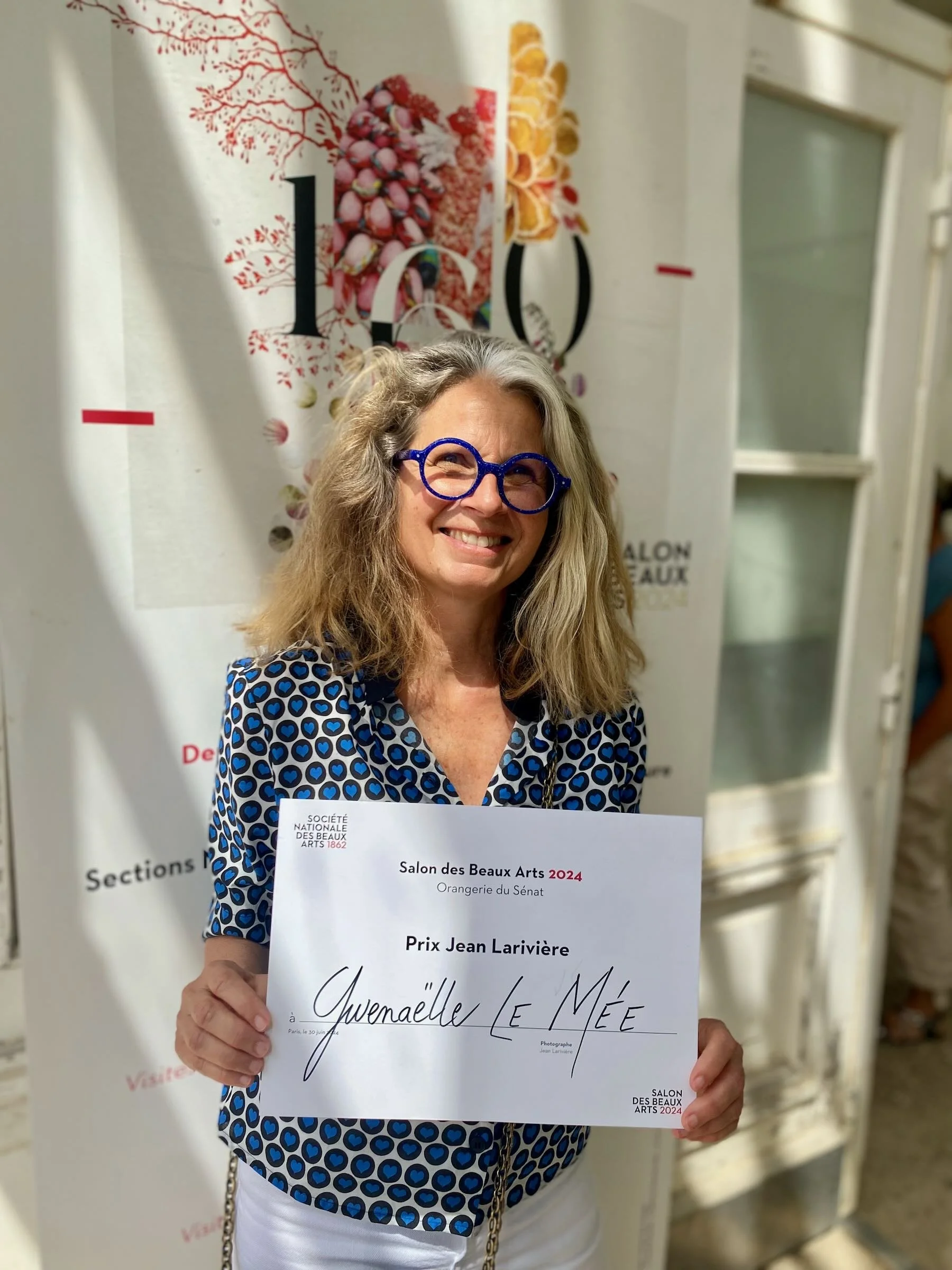
Salon des Beaux Arts sélection 2024, Orangerie du Sénat, Paris 6ème
– Lauréate PRIX Jean Larivière
Festival île de Ré photo
Galerie Sénac (juillet), La Flotte – expo collective
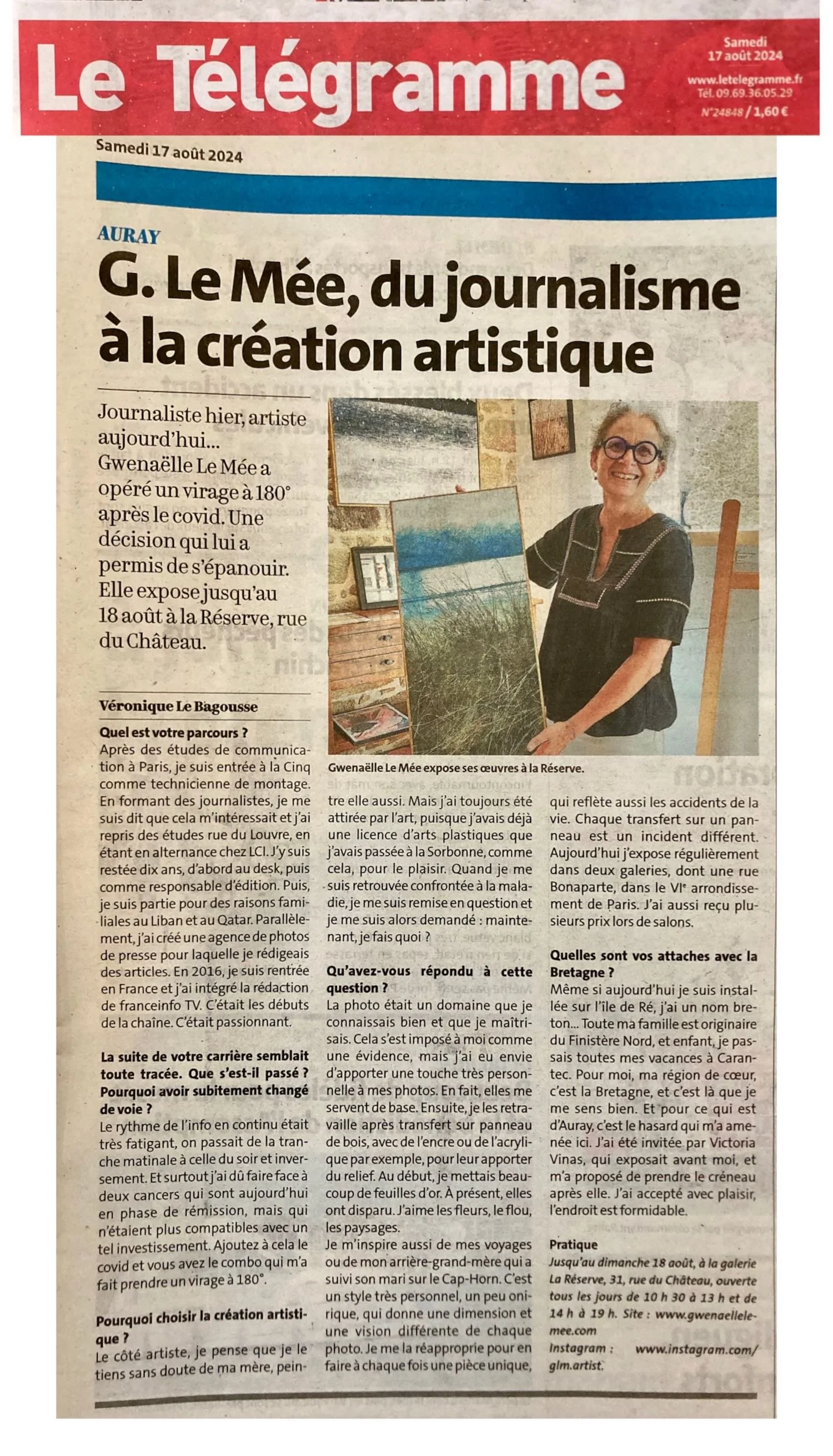
Galerie La Réserve, Auray (Morbihan) – expo solo
Expo4art, Halle des Blancs Manteaux, Paris 4e (27<29 sept.)
Salon d’art contemporain à Bruxelles, Art3F Brussels (22<24 nov.)
-
Galerie Bettina, 2 rue Bonaparte, Paris 6eme
Salon des Beaux Arts, sélection 2023, Réfectoire des Cordeliers, Paris 6eme
Art Capital, Salon des artistes français, sélection 2023, au Grand Palais éphémère, Paris
Galerie des remparts Caroline Canon, Bordeaux
La Mini Galerie, La Rochelle
Galerie Sénac, La Flotte
La galerie du port, exposition solo, Ars-en-Ré
Festival île de Ré photo
Expo4art, Halle des Blancs Manteaux, Paris 4e (15<17 déc.)
-
Salon des Beaux Arts sélection 2022, Orangerie du Sénat, Paris 6ème
Galerie de l’Avant Port, La Flotte, expo solo
Printemps de Fleuriau, La Rochelle
13ème édition d’Arts Atlantic, La Rochelle
Festival des Arts Actuels entre ré et Oléron, 11ème édition
L’Ancre Maritaise, Sainte-Marie de Ré
Résidence à la Galerie Chevalier Gambette, Loix
Galerie Caméléon, Paris 11ème
Prao, La Rochelle
-
12ème édition d’Arts Atlantic à La Rochelle, France
-
10 ème édition d’Arts Atlantic à La Rochelle, France
-
Licence d’Arts Plastiques à l’Université Panthéon-Sorbonne à Paris
Membre de l’équipe d’organisation des Rencontres Artistiques du Qatar
“L’art du dessin” chez l’artiste Catherine Delmas Lett
Worshops au Museum of Islamic Art à Doha, Qatar -
Sculpture à Virginia Commonwealth University à Doha, Qatar
Souk Waqif Art Center à Doha, Qatar
-
2016-2020
Journaliste – Responsable d’édition à Franceinfo
2006 – 2016
Directrice de publication et co-auteure chez Art & Privilège éditions (Liban)
2007 – 2015
Directrice artistique HHO Photolibrary (Qatar)
2005 – 2007
Journaliste – Coordinatrice pour l’agence de presse photo MGA production
1994 – 2005
Journaliste rédactrice et Chef d’édition à LCI
Gwenaëlle Le Mée received the prestigious Jean Larivière Prize at the Orangerie du Sénat at the Salon National des Beaux Arts 2024 in Paris.
The visual artist's works are on display at the Bettina Gallery in the Saint-Germain-des-Près in Paris and at the Sophie Le Mée Gallery on the Île de Ré, on the French Atlantic coast.


Press